
To figuring it out...
*Thank you Canadian off-gridders!

The other day I watched a documentary about people in the far reaches of Canada who are living off the grid. These aren’t preppers or survivalists, just people who, for whatever reason, want to be the ones to produce or procure everything they need to live. They have solar panels, water wells, and ingenious ways to trap heat in their homes in the winter—hundreds of barrels of water in the basement that will absorb and give off heat, or a house made of rubber tires packed tight with dirt that acts as insulation. Another man, a journalist, who wanted to live this lifestyle was traveling around to each of the couples (interestingly, no one featured on the show had children with them) to ask as many questions as he could, to glean information he could put to use.
The journalist visited one couple up in the Yukon Territory who have a huge spread with multiple arrays of solar panels and various generators and homemade turbines. The journalist was gazing around at everything the husband had made and asked, “How in the world did you do all this?” The man said, “Well, I just sort of figured it out.” He said he never imagined making something as big as he’d made, but he started with just one problem. “How do I do this one thing?” Then when he figured that out, it led to something else he needed to figure out, so he’d figure that part out. Which would lead to something else. He said at the end, once he had their whole property outfitted with panels and turbines and generators, he’d look at it and think, “How the heck did I do all that?”
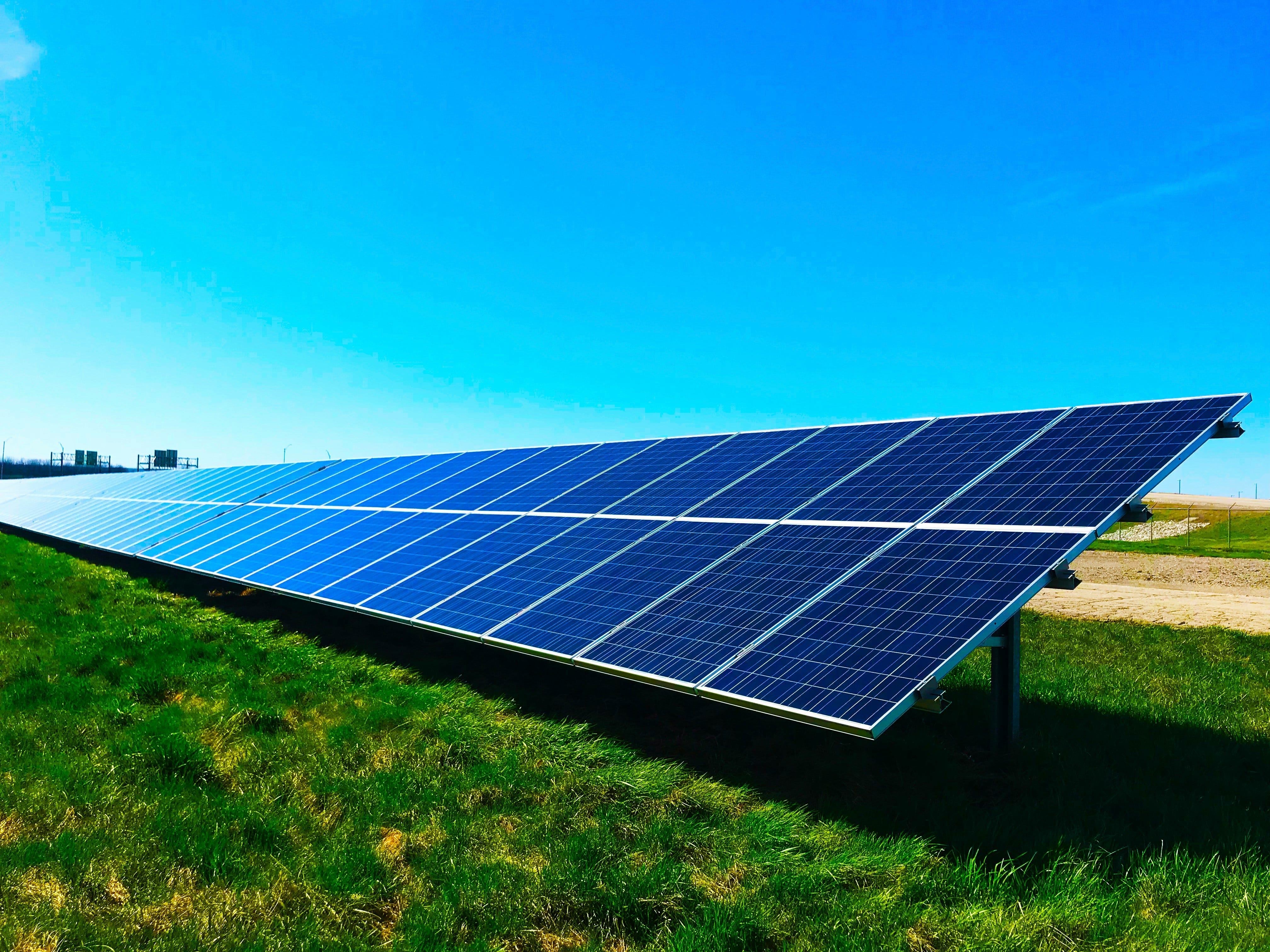
Photo by Chelsea on Unsplash
I found myself smiling as he spoke, because it felt so relatable. That’s exactly how it feels to me to write a book. I have to take my eyes “off the prize,” in a way, because to constantly think about how I’m writing a 300+ page book that will entertain and inspire and thrill and comfort is just too big of a concept to hold in my head sometimes. It’s easier for me to think about it in smaller chunks: what needs to happen in this particular scene? How do I get this character from this mindset to this other one? What will this character say to this one to move them to the next level in their relationship? Or sometimes, it’s even smaller (and harder!): How do I get them out of the parking lot?! [I actually had that problem in an early draft of A Place to Land. Two characters (early versions of Violet and Trudy) were in a grocery store parking lot, and I couldn’t get them out of it!]
All this to say, in a way, a story about Canadian off-the-gridders made me feel a little less alone in my attempt to wrangle 300+ pages. (Moral is, don’t try to wrangle 300+ pages—just wrangle one single page at a time!)
What else is helping me these days at the writing desk?
Classical music in the background. I often have some mish-mash of songs playing on a loop in my mind, usually whatever the girls and I last listened to in the car. It’s frequently something sugary, poppy, and utterly non-helpful when it comes to trying to put words down on the page. I used to put on white noise but I’ve found classical music works better for me. You can search on Youtube for “classical music for studying” and there are several playlists. You can also watch this guy, who I now think about every time I turn on my classical music!
Silly Putty. I’m serious. I have a little red egg of Silly Putty on my desk at all times, and I open it as soon as I sit down. It’s a sneaky little way of occupying my hands while I’m thinking—keeps me from nervously nibbling on my fingernails and/or popping over to Instagram to watch more classical music dancing.
Ruby
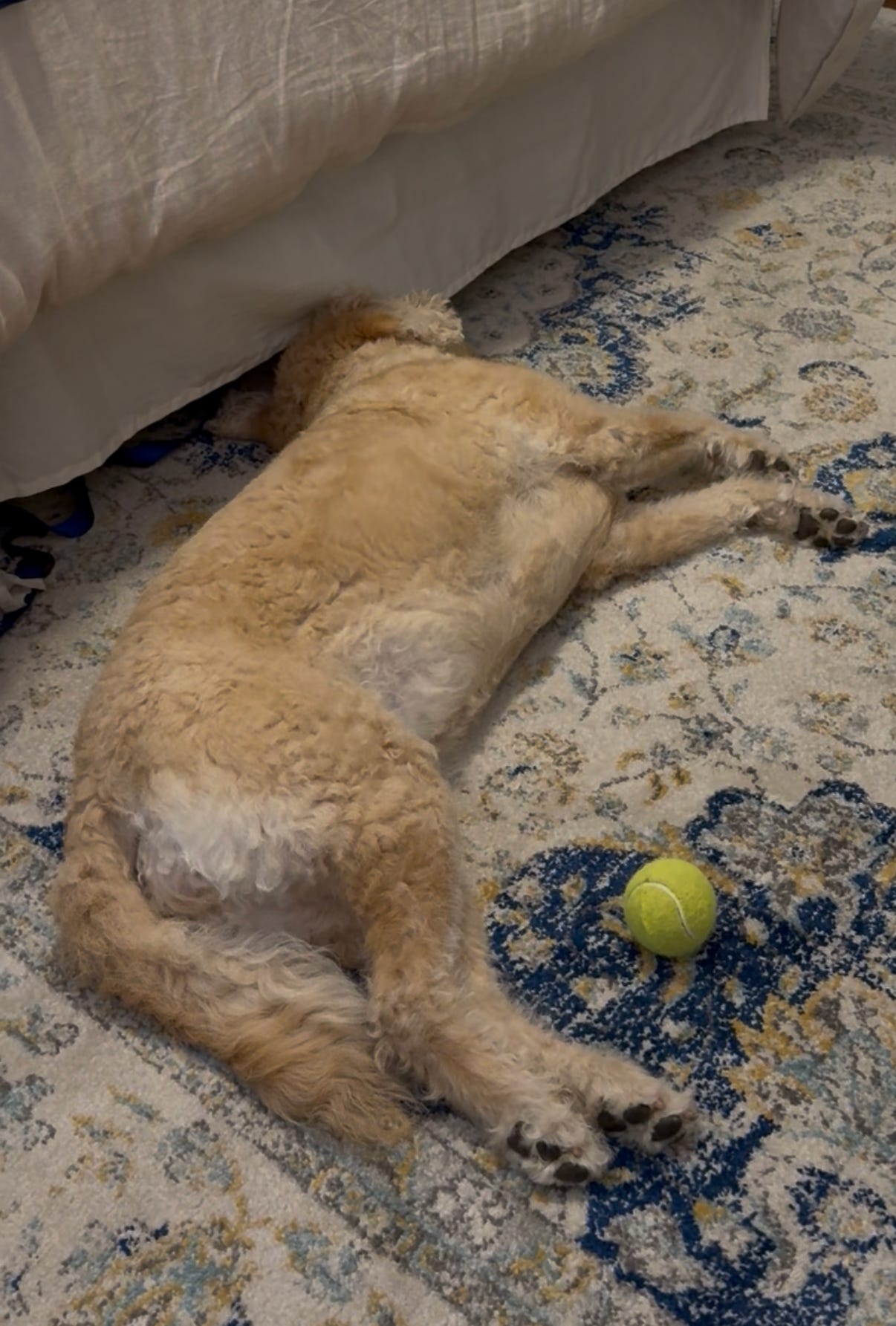
She’s with me every day, snoozing on the rug with her tennis ball nearby. She’s a comfort.
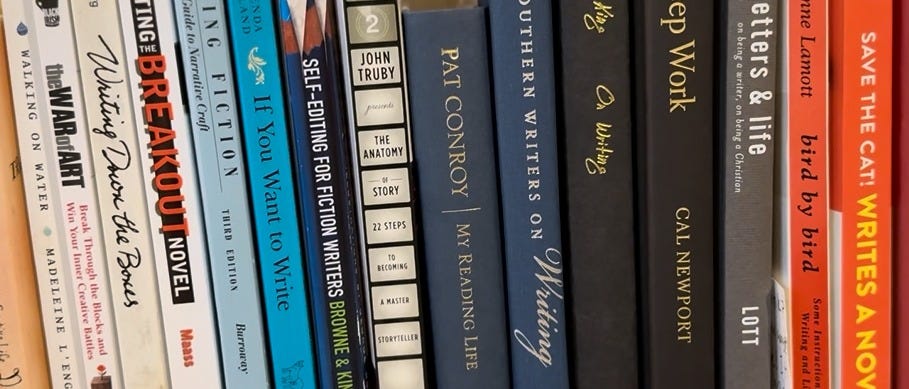
For this particular work-in-progress, I read Jennie Nash’s Blueprint for a Book before beginning. This particular craft book has been helpful for me because it directs you to create a “Because of That” summary, where one thing causes another thing, which causes another thing…so ideally you have a loose outline of connected “things” rather than a bunch of scene ideas that just sound good. The goal (as with most books on the craft of writing) is to help you keep making forward progress that makes sense…each scene follows logically because you’ve already mapped out the actions (or conversations or thoughts) that spawn the next one. When I feel stuck or like I’m not sure what needs to happen next, it’s helpful to have this summary to look back on and remind me where I’m going.
I’m a bit of a Cal Newport fangirl. Most everything he says about digital minimalism, slow productivity, and focus rings very true with me. If only I could follow all his advice to a T. I have one of his suggestions on a Post-It over my desk. “Focus Hard. In reasonable bursts. One day at a time.” He says our mind starts to disengage 20-30 minutes into hard work, and we have to develop hard focus muscles to fight the feeling and keep working. Reasonable bursts: for me, ideally that’s about 3 hours a day. Occasionally longer, but I have to be careful, or I’ll still be sitting at my desk at 2:40 when it’s time to pick up kids and I turn into a grump because I feel like I was interrupted. I’d rather keep to the “reasonable bursts” so I can do other things in my day as well as write. As for the “one day at a time” part—that keeps me from catastrophizing! Sort of like not focusing on writing the whole book when I sit down to write, but remembering I’m merely writing a scene today. Or maybe even one conversation! Whatever the task is for today, I do it, and try not to worry about tomorrow’s task.
Until I’m finished for the day, that is. Then, I write a few lines of what I’ll focus on the next day when I sit down to write. Occasionally I’ll give myself a great headstart and flush out a whole scene, but usually it’s as simple as “Next, she’ll go buy birdseed” or “flashback then convo with mom.” Something to keep me from staring at a blank space tomorrow and not know how to fill it!
Lastly, I bought an old school, well-thumbed thesaurus, and it makes me unreasonably happy. (Fun fact: your library bookstore is a gold mine if you need to find a good, printed thesaurus or dictionary.) For a long while, the thing that kept me from turning off my wifi while writing was that I often look up words in the online Merriam Webster thesaurus. I’m bad about repeating and overusing words, so I try to vary my word choice, and also sometimes searching for just the right word to convey your thought is a great procrastination tool! I didn’t want to lose my ability to wordsmith when I needed to. Then last week, a lightbulb moment—hello, buy an actual thesaurus! So one trip to the Friends of the Homewood Library bookstore and I have my great little thesaurus and the wifi is off while I write! (Except when I need to look at a map, which I often do while writing. But then I turn it right back off.)
If you’re someone who wrangles words, I’d love to know what your tips and tricks are for yanking those words out of the ether and plunking them down on paper or screen. What’s working for you?
Happy Friday, everyone. Next time, I’ll give some good reading recs! In the meantime, I’d love to know what you’re reading and loving.
Much love.
Lauren, I love the "Because of that" idea. I'll use it!
Beware of busyness--a sin we create and impose on ourselves!
Laura I have returned to you list and want to share. We are in our 3rd and last month vacationing in Lillian Al! I have read your earlier books and loved them. The library here has none of your books and wish they did! The Lillian Library is all volunteer and all donations! I have mentioned your works at the Spanish Cove book group, also! Our home is Bridgewater MA and have been able to get your books through them; however, I love your references to this area and think others here would,also! an avid reader, Brenda